Amazon wants cGMP proof. Does my manufacturer’s certificate count?

You don’t own a factory. Your capsules come from a contract manufacturer two states away, the labels carry your brand, and Amazon’s document request asks for a cGMP certificate. Yours doesn’t exist. So whose do you send?
Don’t worry. You don’t need a factory of your own, and Amazon’s wording answers most of this. Where it says nothing, we’ll tell you so and give you our advice instead.
In This Article
- What does Amazon’s cGMP rule actually test?
- If a contract manufacturer makes it, whose certificate goes in?
- What if your product is made or packed at more than one site?
- Which certificates count if your manufacturer is outside the US?
- Where this goes wrong
- How we check a manufacturer’s certificate
- FAQ
1. What Does Amazon’s cGMP Rule Actually Test?
The facility. Amazon’s US supplement policy says the product must be manufactured in a facility compliant with 21 CFR 111 or 21 CFR 117, or equivalent. Then:
- The cGMP audit or certificate must come from an accredited third party.
- Private, first-party and consulting audits, and FDA inspections, are not accepted.
- The certificate must be in good standing and not expired.
- A current GFSI food-safety certification at the facility may satisfy it.
Nothing in that wording asks whose name is on the brand. The question Amazon asks is where the product was made and whether that place is certified.
Think of it like a delivery-app brand cooked in someone else’s kitchen. The hygiene certificate on the wall belongs to the kitchen, whatever name is printed on the bag.
FDA’s own rule points the same way. 21 CFR 111 applies to anyone who manufactures, packages, labels or holds a dietary supplement. That includes a supplement you manufacture that someone else packs or labels.
2. If a Contract Manufacturer Makes It, Whose Certificate Goes In?
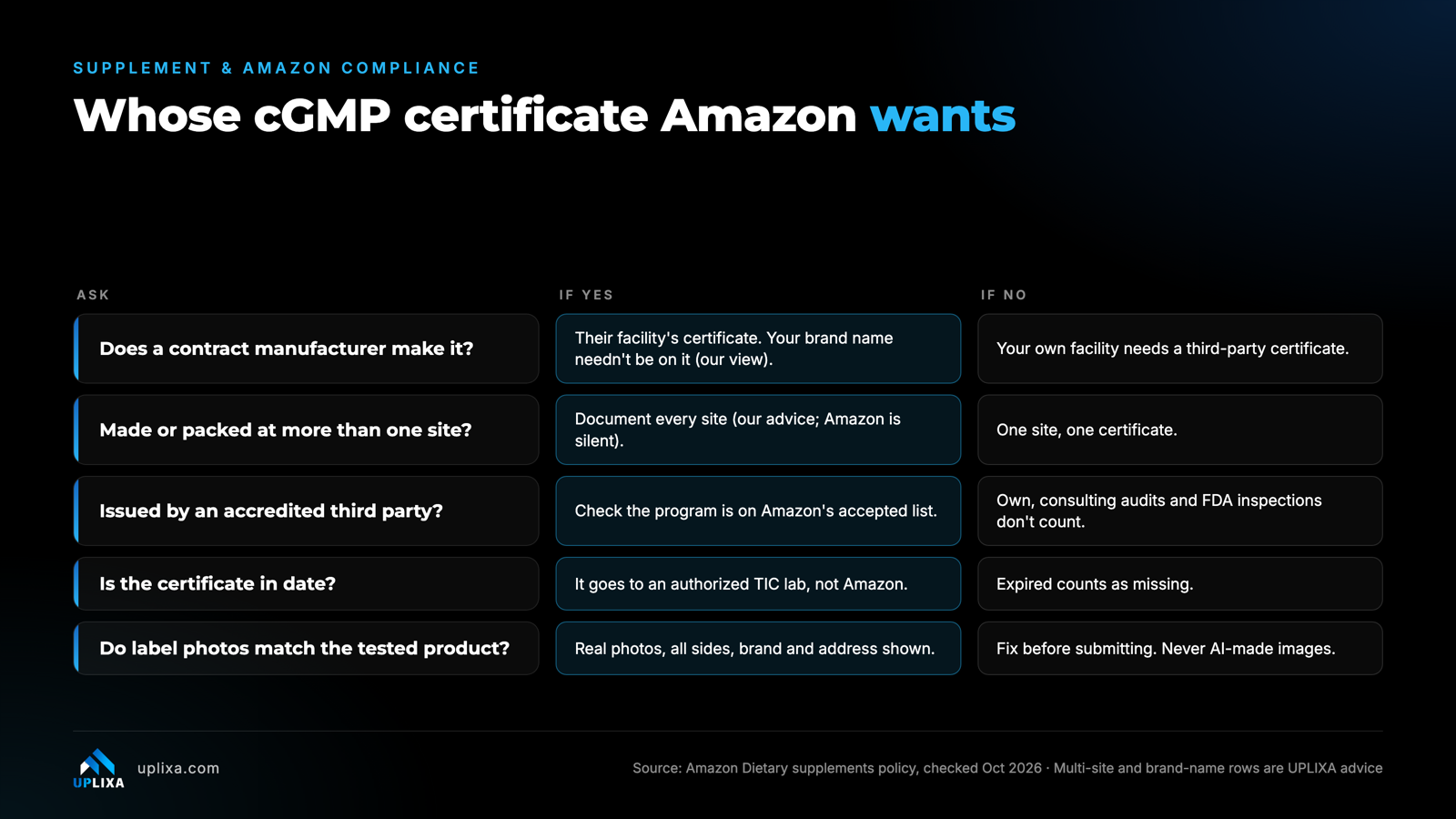
Theirs. To be exact, the certificate for the facility where your product is made, issued by an accredited third party under an accepted program.
Amazon doesn’t say whether your brand name needs to appear on that certificate. In our view it doesn’t. Here’s why. A contract manufacturer’s certificate names the manufacturer and its site, which is what Amazon’s test is about. Your brand shows up elsewhere: on the label, which must show the name and address of the brand owner, manufacturer, packer or distributor.
What needs to match? The product and the facility. The certificate should relate to the actual site making your product, while the label and product images should represent the same product being tested and listed.
What does have to line up is the product. Amazon wants images showing the product is the same as the one tested and listed, from all sides. In our view, a certificate from the right company but the wrong site, or label photos of a different version, can break that chain.
The documents go to an Amazon-authorized TIC lab, not to Amazon. Whoever holds the certificate, it reaches Amazon through the lab.
3. What If Your Product Is Made or Packed at More Than One Site?
Amazon’s policy doesn’t address it. This part is our advice.
- Document every site that manufactures or packs the product. 21 CFR 111 covers packaging and labeling as well as manufacturing, so the packing site matters too.
- Keep one source per ASIN where you can. If units from two suppliers sit under the same ASIN, make sure each one matches the label images and the product that was tested. If they don’t match, they shouldn’t share a listing.
- Watch the head-office certificate. A certificate for a company’s main plant doesn’t cover the satellite site that actually filled your bottles.
4. Which Certificates Count If Your Manufacturer Is Outside the US?
Amazon’s accepted list includes foreign and international schemes, and it says the list isn’t exhaustive:
- EudraLex Volume 4 GMP certificates from EEA national competent authorities.
- PIC/S GMP (PE009-17) from a participating authority.
- Korea MFDS GMP establishment certificates.
- A Health Canada site licence.
- TGA GMP.
- ISO 22000 and Codex CXC 1-1969.
- GFSI-benchmarked schemes such as SQF edition 9, BRCGS issue 9, FSSC 22000 v6, IFS Food v8 and GRMA (NSF/ANSI 455-2).
The same conditions still apply. Third party, accepted program, in date.
5. Where This Goes Wrong
The certificate expired last month
Amazon says it cannot be expired. From our end, an expired certificate is a missing one.
The manufacturer sends its FDA inspection report
It doesn’t count for supplements. Ask for the third-party certificate instead.
The formula changed, the listing didn’t
A manufacturer changes a formula and one bullet still quotes the old milligrams. That’s the kind of mismatch Amazon’s ingredient-weight rule targets.
The rebrand
After a rebrand, the labels and listings must match. We handled Kala Health’s brand name change to Procapsin. For a supplement brand going through the same thing, the label photos you send the lab should carry the name on the listing.
6. How We Check a Manufacturer’s Certificate
We don’t have a published case for this question, so here is our method. From our end, it starts with one written request to the manufacturer for:
- A copy of the certificate.
- The certifying body, and evidence it’s accredited.
- The program or standard it certifies against.
- Issue and expiry dates.
- Every site address the certificate covers, matched against where your product is made and packed.
- Testing documents, if your product sits in one of Amazon’s five testing categories (bodybuilding, joint health, sexual enhancement, sports nutrition, weight management).
If a manufacturer refuses, we ask again in writing, offer to have the certifying body confirm it directly, or offer an NDA. If they still won’t share it, consider changing supplier.
7. FAQ
Whose cGMP certificate should I submit if I use a contract manufacturer?
Use the certificate for the facility where your supplement is manufactured. It should come from an accredited third party under an accepted program and cover the actual production site.
Does the cGMP certificate need to show my brand name?
Amazon’s wording focuses on the manufacturing facility and its certification. It does not specifically state that the brand name must appear on the certificate.
Can I submit an FDA inspection report instead?
For US dietary supplement cGMP requests, the policy described in this article does not accept FDA inspections as a substitute for the required third-party certificate.
What if my product is manufactured or packed at multiple facilities?
Keep documentation for each relevant site and check that the certificates cover the locations where the product is actually manufactured or packed.
Can I use an expired certificate?
No. The certificate must be current, in good standing, and not expired.
Need help with an Amazon supplement compliance request? UPLIXA can help review your documentation, identify certificate gaps, and organize the evidence needed for your compliance submission.


Comments
Post a Comment