Amazon Supplement Listing Removed? Key Reasons, Compliance Checks & Red Flags

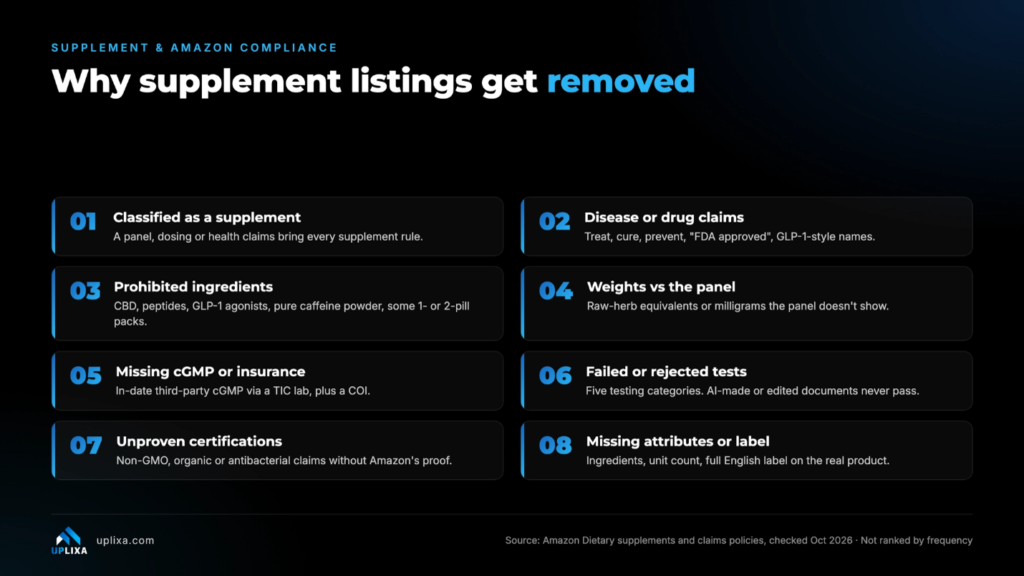
Your top-selling supplement has been deactivated in Manage Inventory. Your Account Health flagged a policy violation. However, the notice doesn't describe the claim, image, or document behind the decision.
As a seller, the greater challenge is not getting a listing reinstated. It's figuring out what caused the removal and protecting other ASINs from the same infraction.
UPLIXA's approach in evaluating supplement compliance is to examine the policy notice, supporting documents, product label, and listing. The policy notice identifies the issue at hand, and the documents help pinpoint the changes needed.
This blog will cover the common reasons for Amazon listing removal for dietary supplements, the policy documents Amazon evaluates the tests and compliance requirements that can lead to supplement listing deactivation and how to prevent the same issues from occurring across multiple ASINs.
How Does Amazon Identify a Dietary Supplement?
The presence of a Nutrition Facts panel does not preclude a product from being a dietary supplement. If the marketing and labeling of the product suggest it is intended to be used as a supplement, and its ingredients are typically found in supplements, the product may be classified as a dietary supplement.
The supplement category a product falls into may determine the type of compliance requirements it must meet.
Common Indicators Include:
- Supplement Facts
- Dietary Supplement
- Herbal Supplement
- Vitamin
- Mineral
- Amino acids
- Botanicals
What Listing Claims Can Trigger Removal?
The following table highlights common supplement listing claims that may trigger Amazon policy violations or listing removal.
| Policy Concern | What Can Trigger Removal? | Example / Red Flag |
|---|---|---|
| FDA Approval Claims | Falsely claiming or implying FDA approval. | "FDA Approved Supplement" |
| Disease-Related Claims | Claiming to diagnose, treat, cure, or prevent diseases. | "Cures Diabetes" |
| Prescription Drug Claims | Comparing supplements to prescription drugs or mislabeling drugs as supplements. | "Works Like Prescription Medicine" |
| Steroid-Like Claims | Promising effects similar to anabolic steroids. | "Legal Steroids" |
| Misrepresentative Labels | Using labels indicating products are not intended for retail sale. | "Tester" / "Not for Retail Sale" |
| Disease-Related Keywords | Adding disease-related terms to backend search keywords. | "Cancer Treatment" |
| Misleading Ingredient Quantity | Exaggerating ingredient amounts or omitting required ingredient information. | Claiming 500 mg when the product contains 250 mg. |
What Documents, Tests, and Labels Must Sellers Provide?
Documentation may show that a listing is not in violation of certain policies, but inconsistent test results or misleading ingredient information can still lead to listing removal.
i. Manufacturing and cGMP Documentation
US regulations for dietary supplements manufactured under current Good Manufacturing Practice (cGMP) are found in 21 CFR Part 111. For food manufacturing under cGMP, refer to 21 CFR Part 117.
Documents submitted must meet Amazon's current requirements, including any applicable third-party verification and/or authorized testing and inspection. Facility registration and certificates of compliance must be current, and the applicable requirements should match your product category.
ii. Product Liability Insurance
Sellers must provide proof of product liability insurance that meets the applicable compliance requirements and submit a Certificate of Insurance through Amazon's verification process.
The insured business, policy terms, and coverage must meet the requirements. An insurance document that doesn't meet Amazon's requirements will not resolve the issue.
iii. Laboratory Testing
Additional tests may be required to ensure that supplements do not contain heavy metals, microbial contamination, or adulterants.
Amazon may require specific tests or supporting documentation for certain products. Listing a product that does not meet Amazon's requirements can result in its removal.
iv. Authentic Documents and Product Images
Supporting records must be genuine and unaltered. Amazon may reject records that do not meet its authenticity requirements, including computer-generated or AI-generated records.
Product images must show the actual product and its packaging, including all required labeling and information in English, such as:
- Dosage and usage
- Directions for use
- Warnings and advisories
- Certification marks and label information
- Lot codes, if applicable
- Name and address of the brand owner, manufacturer, packer, and/or distributor
To view a larger version of the images, click on the images.
Why Can Certain Terms Cause Issues?
Certain words can introduce additional documentation requirements or change how Amazon reviews a product.
Non-GMO
Amazon may require a certificate identifying the specific product or an appropriate PCR laboratory report. Check the current rules for report validity and the required issue date.
Organic
Products making organic claims may require USDA organic certification, as applicable, with the certifier identified according to Amazon's requirements.
Antibacterial, Antimicrobial and Antifungal
These terms may raise concerns about pesticide regulation, depending on the product and its intended use. They may also involve claims restricted by Amazon for supplements.
Claims and supporting evidence must align across the product, images, and packaging. A claim that appears harmless in a graphic can still create a compliance issue.
Where Can I Find the Removal Notice in Seller Central?
Look in the sections where Amazon records listing and policy concerns:
Account Health
Review Product Policy Compliance for listings with Food and Product Safety Issues or Restricted Product Policy Violations, if applicable.
Manage All Inventory
Check the listing status and any compliance or deactivation messages.
Activate Listings
Look for requests to provide information or resolve an outstanding issue.
Performance Notifications
Read the full notice and any instructions regarding documentation, appeals, or corrective action.
Save the wording from each notice. If there are differences between the notices, save both rather than assuming one replaces the other.
This helps determine whether the concern relates to a prohibited claim, missing document, laboratory testing, product identity, or another policy requirement.
Common Mistakes That Make Compliance Problems Worse
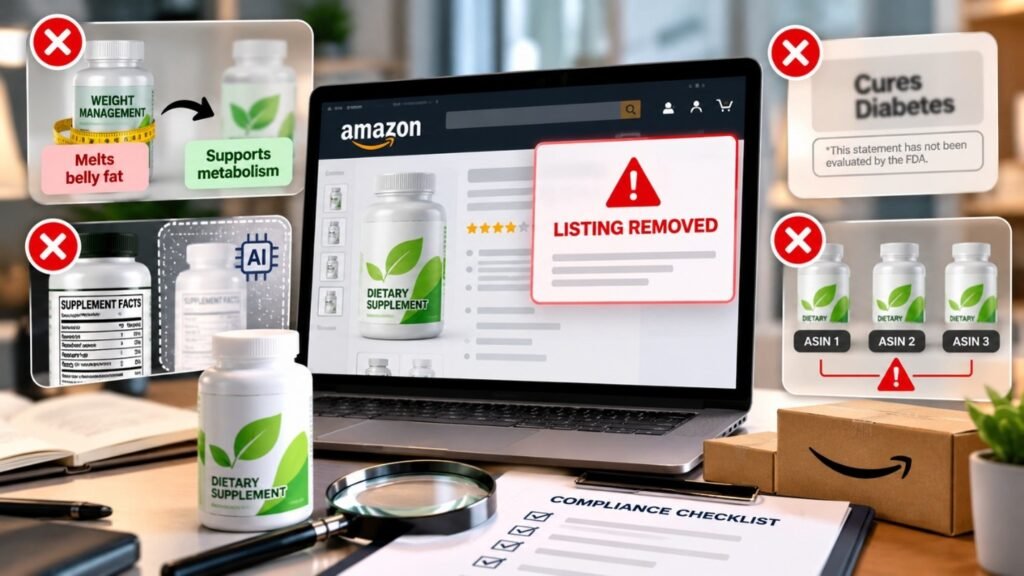
1. Rewriting a Claim Without Checking the Category
Replacing "Melts belly fat" with "Supports metabolism" does not automatically fix a policy concern. In this example, the revised wording may still place the product in the weight management category or require further review.
2. Using a Rendered or AI-Generated Label
A graphically pleasing image cannot replace an actual photograph of a product and its label. If the Supplement Facts panel, ingredient quantities, or warnings shown in an image do not align with the physical product label, this can create a policy concern.
Review and analyze all visible details of the product and its label, and use actual product images before submission.
3. Adding a Disclaimer Instead of Removing a Prohibited Claim
Disclaimers do not make previously prohibited claims acceptable. The underlying claims must be removed or corrected for the disclaimer to be meaningful.
4. Correcting One ASIN While Ignoring Similar Listings
Discrepancies in descriptions, images, or ingredient claims may be present across multiple ASINs. Investigate related products for the same discrepancies instead of modifying only the listing that received the first notice.
How to Approach an Amazon Supplement Listing Removal
A structured approach helps sellers focus on the actual compliance concern rather than making arbitrary changes.
Locate the relevant communications in Account Health, Manage All Inventory, and Performance Notifications.
Review claims, images, keywords, ingredients, quantity, and packaging.
Check certificates, laboratory reports, manufacturing documents, insurance, and other relevant records.
Correct or remove claims as needed and provide missing information.
Look for the same issue across the seller's catalog.
Provide the information requested or appeal with supporting evidence, following the instructions in the notice.
Final Thoughts
Compliance with Amazon for supplements is more than just writing compliant product descriptions. There are claims, ingredient amounts, packaging, laboratory test reports, and manufacturing records that must align with applicable requirements.
When a listing is removed, the first step toward a complete correction is identifying the exact reason for removal. Recurring issues across related ASINs also give sellers an opportunity to address similar problems before they affect other listings.
At UPLIXA, our strategy is to review the evidence, identify the compliance gap, and help sellers decide on the best course of action. The goal is to solve the problem as accurately as possible, not just make the listing look compliant.


Comments
Post a Comment