Amazon Product Launch Strategy: A Complete Guide to Successfully Launching, Ranking, and Scaling New Products on Amazon for Maximum Sales

Launching on Amazon should be one of the first steps in any eCommerce endeavor, as it is one of the most crucial steps. A solid launch gives a new product the ability to gain traction and sales and assists with listings with Amazon’s SEO. A launch that is done poorly results in lost sales, low conversions, and unnecessary spending on marketing.
This guide covers the entire Amazon product launch strategy,
from the pre-launch phase and actual launch to the post-launch phase,
including scaling for growth.
Why Does an Amazon Product Launch Strategy Matter?
Amazon has a complex algorithm that evaluates sales,
reviews, and conversions. A strategic launch generates sales and conversions,
which, in turn, results in a better review rating. It can help a product start
the momentum it needs to rank for the most sought-after keywords.
Product launch advantages:
- Improved product ranking
- Improved product visibility
- Improved conversions
- Improved ads
- Improved brand trust
- Improved sales that are sustainable over time
Amazon Product Launch, Ranking & Scaling Strategy: A Simple & Complete Guide for Maximum Sales
Launching a product on Amazon is a step in the right
direction, but it must be part of a larger system that includes product
selection, listing, ads, rank, and scale. Below is an easy-to-follow
step-by-step system to help you build a successful Amazon business.
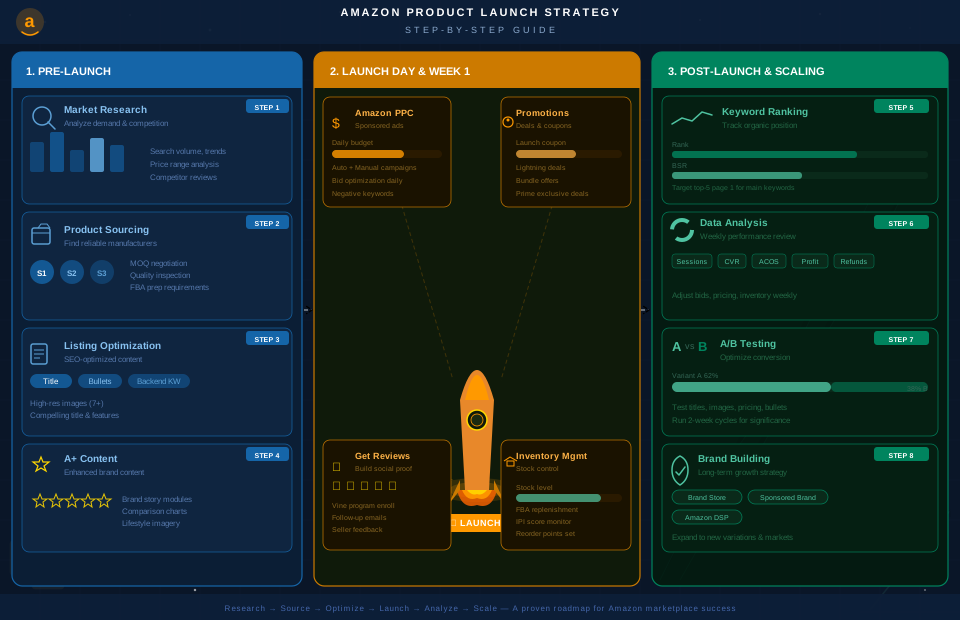
Step 1: Start with Strong Product Research
Product research is the foundation of any Amazon launch. You
should avoid unnecessary resource expenditure on the product’s inventory,
branding, packaging, and advertising components until you have validated the
product’s demand and the likelihood of the product’s success. Most of the time,
the best opportunity lies in a product with consistent demand and a moderate
level of competition.
Answer the following questions to assess research quality:
- Is demand consistent?
- Are there users searching for this product?
- How competitive is the landscape?
- What improvements can I make?
- Is there profitability after all the Amazon costs?
- Can I source the product?
- Is there seasonal versus year-round demand?
Step 2: Study Your Competitors Carefully
Competitor analysis gives insight into your product category
and allows you to improve your listing to avoid the mistakes that your
competitors and predecessors made. Going through customer complaints will give
you the common issues and complaints that can be easily addressed by the
features of your product. You can inform your customers that you offer
packaging that is stronger and sturdier and a greater/better instruction guide
and added accessories.
Some of the things you should look for are:
- How the product title is structured
- Style of the core image
- How the bullet points are structured
- How the price is set
- Quality and count of reviews
- Product rating
- A+ Content
- Customer complaints
- Selections in packaging and bundling
- Shipping and delivery
Step 3: Build a Competent Keyword Strategy
An Amazon listing is a website, and product search is a
keyword search. Without a keyword strategy, your launch will be pointless, even
if you have the best product.
A keyword strategy includes these elements:
- Primary keywords
- Long-tail keywords
- Buyer-intent keywords
- Competitor keywords
- Backend keywords
Some example keywords are:
- Stainless steel water bottle
- Insulated water bottle
- Leakproof water bottle
- Gym water bottle
- Travel water bottle
Note: Primary keywords should be included in
product titles and bullet points, product descriptions, backend keywords, and
PPC campaigns. Avoid keyword stuffing, as this makes your listing look
unnatural and hard to read.
Step 4: Prepare Your Keyword Strategy Before Launch
Keywords are the basis of Amazon ranking. If a listing is
not optimized for the correct keywords, a product will likely not be seen by
the right users. A good keyword strategy will include three types of keywords.
Primary Keywords:
These are highly searched and relevant keywords.
Example:
If someone sells a water bottle, a primary keyword can be
“Stainless Steel Water Bottle.”
Secondary Keywords:
These are related searches and are supportive to the primary
keyword.
Examples:
- Insulated Water Bottle
- Leakproof Water Bottle
- Reusable Water Bottle
- Water Bottle for Gym
Long-tail Keywords:
These are keywords with high search volume that are very
specific. These keywords are good to use, as they usually lead to a sale.
Keywords and phrases should be included throughout a listing. This includes,
but is not limited to, the title, bullet points, the main body description, and
backend search terms.
Step 5: Create a High-Converting Product Listing
Your product listing is your sales page, and a poor listing
will drain the budget your ads worked for. Rather, a great listing will inform,
and most importantly, convert. Amazon suggests great product detail pages have
product information, images, strong titles, bullet points, and descriptions
that are clear.
I. Optimizing your Product Listing Title
Your title should be a readability-focused compilation of
the product and feature keywords. As such, good titles will have the product
keyword, feature, size, quantity, material, and possibly the use case.
The components of a great title are:
- Product keyword
- Brand name
- Product feature
- Size/Quantity
- Use case
- Benefit
An example of this is:
Brand Name + Main Keyword + Key Feature + Size/Quantity +
Main Use
Bullet Points That Sell
To do this, bullet points should be focused on and clearly
express the benefits of the product feature.
This is better expressed as
- This
product is made with stainless steel
Instead, it should be:
- This
product is made with stainless steel, which makes it strong and prevents
the product from rusting, so it is made for long-lasting everyday use.
II. Images That Cultivate Trust In Your Audience
Images are essential in Amazon listings. Because customers
can’t physically interact with the products, your images sell the product for
you. Your images should aim to answer any customer concerns before they commit
to reading the product listing.
Your image collection must contain:
- White background main images
- Product in use lifestyle images
- Images featuring key product attributes in infographic format
- Images featuring product size/dimensions
- Comparison images
- Images showcasing product packaging
- Images featuring different ways to use the product
- Images that highlight product quality in a close-up
Step 6: Use A+ Content for Better Brand Presentation
If your brand is part of the Amazon Brand Registry, Amazon
offers A+ Content as a segment of the product detail page, which is an
opportunity to enhance the page through the addition of text, images, modules,
charts, and elements of your brand’s story. Amazon views A+ Content as a
feature for brands to present their products using rich elements of images,
videos, texts, and comparison charts.
The elements of A+ Content help you to
- Present additional and descriptive benefits of the product
- Enhance the credibility of the brand
- Illustrate the various use cases of the product
- Present comparisons of the various product offerings
- Instill confidence in the customer to complete the purchase
Step 7: Prepare Inventory and Fulfillment Properly
An unsuccessful product launch is often the result of poor
inventory planning. If you run out of stock during launch, your ranking likely
will too, and ads will be ineffective. Fulfillment by Amazon (FBA) lets sellers
outsource order fulfillment, customer service, and shipping using the Amazon
fulfillment network. Most sellers find that FBA increases customer confidence
because customers tend to prefer fast delivery. However, you should consider
the costs of storage, fulfillment, and the limits of your inventory when you
send stock.
Before launching, confirm you have:
- Inventory to meet expected demand
- Planned inventory replenishment
- Set expectations for suppliers
- Buffer inventory
- Inventory packaging
- Plans for Amazon shipments if you are an Amazon seller
Step 8: Build a Pre-Launch Checklist
Carefully prepare everything before your product goes live.
A poor launch often results in irreversible issues leading to poor conversions
and rankings. The stronger your plan, the stronger your first 30 days will be.
Before launch, make sure:
- All product details are entered.
- The product title is entered and optimized.
- All bullet points, descriptions, and backend keywords are entered.
- All images, including the main, lifestyle, and infographics, follow Amazon’s standards.
- A+ content is completed.
- The product has the desired price with a planned promotion.
- PPC campaigns are prepared.
- Safety stock is fulfilled.
- Brand Registry is set up (if applicable).
Step 9: Launch with Smart Pricing
Smart pricing and a strong sales strategy will help you meet
your launch goals, especially since customer reviews are lacking at the initial
launch stage. But no pricing with no strategy. Pricing too low can lead to
increased sales at a cost to your profit margin and an increase in difficulty
for scaling.
You can consider a number of things, such as:
- Competitive introductory pricing
- Coupons
- Limited-time promotions
- Bundle value
- Quantity discounts
- Subscribe & Save
The ideal launch pricing strategy finds a balance among the following:
- Attracting customers
- Protecting profits
- Positioning for your brand in the future
Step 10: Use Amazon PPC to Drive Early Visibility
Amazon PPC should be one of your top considerations for
product launch. New products get limited organic ranking. You need to be in
front of the shopper with ads. Amazon Sponsored Products ads show in shopping
results and product pages.
- Recommended
PPC Campaign Structure
An effective campaign should have the following:
- Automatic
Campaign
Use this to get the search terms Amazon has for your
product.
- Manual
Exact Match Campaign
Use this for your top keywords.
- Manual
Phrase Match Campaign
Use this to get keyword variations.
- Manual
Broad Match Campaign
Use this for keyword discovery.
- Product
Targeting Campaign
Choose a competitor listing or a related product.
Common Amazon Launch Mistakes That Hurt Rankings & Sales
Launching a product with Amazon and finding success can be
difficult if you make the following common mistakes.
Mistake #1: Launching Without Research
Selecting the wrong product usually means low sales.
Mistake #2: Weak Product Listings
Listings that lack quality lead to low conversion.
Mistake #3: Insufficient Advertising
Advertising is required for products to pick up sales.
Mistake #4: Ignoring Customer Feedback
Feedback is essential for improvement.
Mistake #5: Poor Inventory Management
You’ll lose sales and rank if you run out of stock.
Mistake #6: Expecting Instant Results
You must be patient and willing to change to find success
for most products.
Launch, Rank & Scale: The Complete Amazon Product Launch Success Checklist
Before Launch
- Product research
- Listing optimization
- Product enhancement photos
- PPC setup
- Stock up
- A+ Content
During Launch
- Watch sales
- Keyword sales tracking
- Ad optimizations
- Inventory control
- First sale traffic
After Launch
- sales data review
- Secondary sales listing optimization
- Broaden sales keywords
- Scale winning ad sets
- Business growth plan
Conclusion
Success on Amazon is an ongoing process after the product launch. Success is the combination of research, perfected listings, and keyword PPC advertising and constant monitoring. Focus on both the launch and scale of the product to achieve sustainable sales. The Amazon marketplace may be extremely competitive, but an effective and thoughtful launch strategy will accelerate your product’s growth and create a sustainable advantage within its category. Strong, sustainable growth builds on continuously improving your listing, learning and analyzing customer behavior, optimizing your advertising campaigns, and effectively managing your inventory.


Comments
Post a Comment